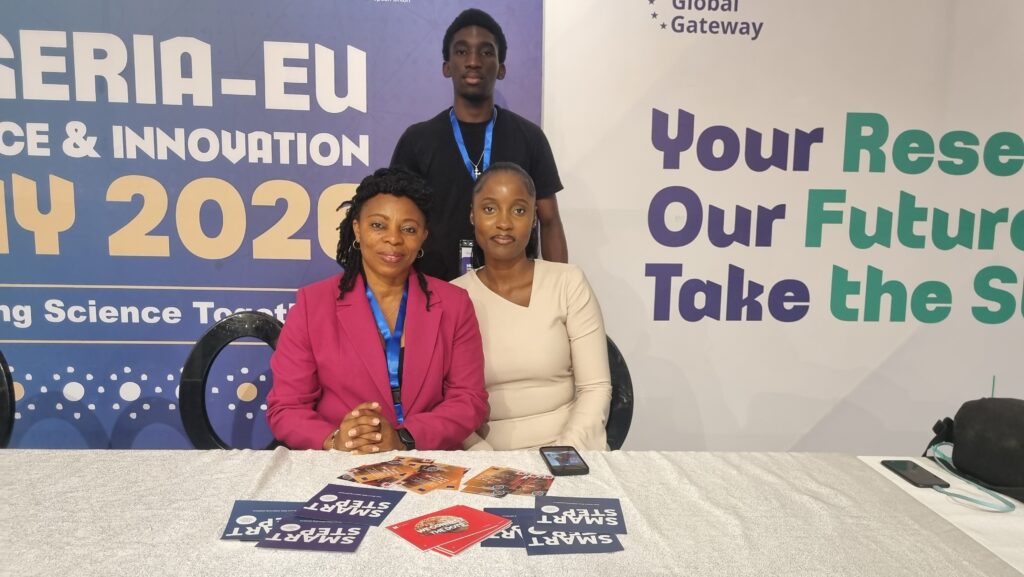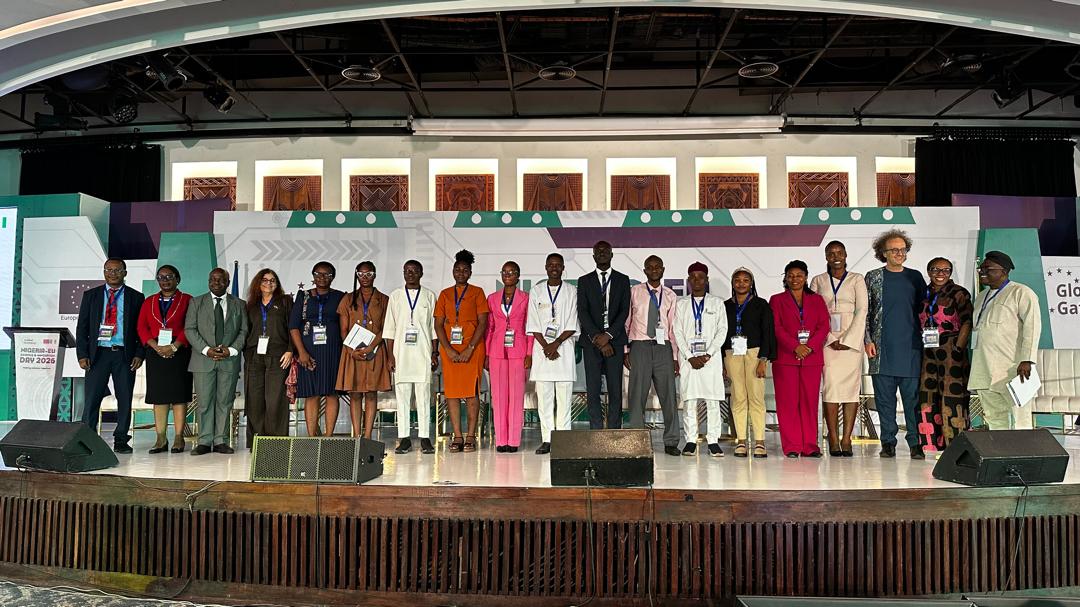
Apodissi played a major part in the science and innovation movement birthed at the Nigeria–EU Science and Innovation Day held at the Wole Soyinka Centre for Culture and Creative Arts, National Theatre, Lagos.
The event which brought policymakers, researchers, innovators, and private sector leaders from both regions together aimed to deepen scientific cooperation under the theme, “Making Science Together.”
Researchers Showcase Innovations to Address National Challenges
A major highlight of the event was a researchers’ pitching session, where 10 Nigerian researchers presented innovative solutions addressing critical national challenges in healthcare, agriculture, environment, technology, and economic development.
The initiative, coordinated by Apodissi, attracted over 60 research submissions from universities across the country before being narrowed down to 10 finalists.
General Manager of Apodissi, Margherita Trestini, described the session as a transformative process which provided one stage to bring young and early career researchers work on stage, bringing home grown science in Nigeria known to the public.
“First of all we are happy to contribute to the second edition of the Nigeria-EU Science and Innovation Day. We worked closely with Dr. Leila Ben Amour Mathieu, Head of Section for Human Development at the European Union Delegation to Nigeria and ECOWAS to introduce a session offering space to early career and young Nigerian researchers to introduce themselves to the wide public and challenge their communication skills .
“It was a rigorous process. Our team has launched the open call for researchers on the event’s website, coordinating with academic jurors and promoting the opportunity across our academic partners and network. We are proud to have ten early career researchers presenting findings tailored to Nigeria’s most pressing challenges in health, environmental studies, and technology,” she said.
At the end of the competition, Badmus Oladimeji Gabriel of Lagos State University emerged as the overall winner, followed by Busolami Elizabeth Oluwadamilare of Bowen University in second place, and Mukhtar Yahya Bebeji of Bayero University Kano in third position.
Trestini said the initiative demonstrated how local research can be translated into innovations capable of addressing Nigeria’s development needs.
The Apodissi team also participated and contributed to the event presenting in the innovation space the Smart Step eLearning platform – https://smartstep-community.com/en/ which provided free access and link with over 100 new learners joining the platform on the spot.
Nigeria, EU Launch New Era of Research Collaboration
Giving his remarks earlier, the Minister of Innovation, Science and Technology, Dr. Kingsley Tochukwu Udeh, the Permanent Secretary of the Ministry, Mr. Philip Ndiomu Ebiogeh, revealed that Nigeria and the European Union have commenced negotiations on a landmark bilateral agreement on Science, Technology and Innovation (STI), signaling a major step toward strengthening international research collaboration and positioning Nigeria’s innovation ecosystem for global competitiveness.
Ebiogeh described the negotiations as a pivotal moment for Nigeria’s research internationalisation agenda.
“I congratulate the EU Ambassador to Nigeria and ECOWAS over the commencement of negotiations of a bilateral STI agreement between Nigeria and the EU. This marks a pivotal moment for us in Nigeria as we are about to commence a research internationalisation agenda,” he said.
He reaffirmed the Federal Government’s commitment to the partnership, stressing that collaboration would enable Nigeria to harness global knowledge systems and strengthen its national innovation capacity.
Quoting an African proverb, he noted, “When spiders team up together, they can tie up an elephant. That’s what we want to do. The EU and Nigeria want to tie up that elephant on STI, and to succeed, the collaboration must work.”
Ebiogeh explained that while the Ministry of Innovation, Science and Technology is leading the negotiations, implementation will involve multiple ministries through the Inter-Ministerial Committee on Research, Innovation and Science chaired by Vice President Kashim Shettima.
He highlighted the enormous opportunities embedded in the partnership, including access to major EU research programmes such as Horizon Europe, Erasmus+, and other international collaboration frameworks.
“Knowledge should not be constrained by boundaries. Collaboration enhances the free flow of ideas, such that what appears to be a problem in one place may already have been solved elsewhere,” he said.
According to him, Nigeria’s priorities for collaboration include agricultural productivity and food security, healthcare and pharmaceuticals, industrial innovation, and space technology, all of which are critical to achieving the country’s ambition of building a $1 trillion economy.
He also disclosed that Nigeria plans to establish a National Research and Innovation Fund to support joint research initiatives with global partners, including the EU.
“If Nigeria could bring €5 million, we could leverage matching grants of €25–30 million. That is a window for us to quickly jump into and make that partnership work,” he said, adding that Nigeria is now “open for business” in international research collaboration.
EU Commits Funding and Strategic Partnerships
In his welcome address, the European Union Ambassador to Nigeria and ECOWAS, Ambassador Gautier Mignot, said the forthcoming bilateral agreement would create an inclusive framework to strengthen scientific cooperation and reaffirm shared commitment to science-driven development.
“The theme ‘Making Science Together’ underscores co-creation rather than single transfer, and a shared commitment to building solutions grounded in joint ownership,” he said.
Mignot noted that the EU’s Global Gateway Strategy is already supporting Nigeria’s digital transformation and innovation ecosystem.
He disclosed that a €13.6 million digital transformation programme is helping the National Information Technology Development Agency (NITDA) strengthen Nigeria’s digital ecosystem and deliver innovation and business training to more than 6,000 women and youth.
He also mentioned a €22 million grant to support the expansion of Nigeria’s fibre-optic network, which is expected to extend national fibre coverage by 14,000 kilometres and enhance connectivity, infrastructure quality, and digital inclusion.
“Building on these achievements, the Nigeria–EU Science and Innovation Day is intended to open pathways for continued collaboration, formal initiatives, and long-term cooperation. We believe science can help us build a better future for all,” he said.
Education Sector Reforms Strengthen Research Ecosystem
Also speaking, the Minister of Education, Dr. Maruf Tunji Alausa, represented by his Special Assistant on Research and Innovation, Dr. Lolade Adeyemi, said Nigeria is implementing sweeping reforms to strengthen STEM education and research capacity.
She revealed that the Federal Ministry of Education has rehabilitated 18 medical schools, established STEM-focused institutions, and created a Research Innovations Commercialisation Committee to bridge academia and industry.
Other initiatives include partnerships under the AWS Academy programme, diaspora research collaboration efforts, teacher training in artificial intelligence and digital competencies, and infrastructure upgrades in technical colleges.
“These efforts reflect Nigeria’s commitment to transforming education into a driver of research excellence, innovation, and economic growth,” she said.
Nigeria Positioned for Greater Participation in Global Research
The Head of Unit International Cooperation in the European Commission, Directorate-General Research & Innovation at the European Commission, Ms. Nienke Buisman, said Nigeria is already among the top African participants in the EU’s Horizon Europe programme, which funds research in health, digital innovation, climate resilience, and agriculture.
However, she noted that Nigeria currently ranks eighth in Africa, highlighting significant room for growth.
“There is potential for Nigeria to become the leading African country in Horizon Europe participation. We are already collaborating on projects tackling malaria, Lassa fever, climate resilience, and AI-driven solutions in agriculture and renewable energy,” she said.
She added that the new bilateral agreement would strengthen partnerships, align research priorities, and unlock greater funding opportunities for Nigerian researchers and institutions.
New Chapter in Nigeria–EU Innovation Relations
The Nigeria–EU Science and Innovation Day marked a significant milestone in deepening bilateral scientific relations, reinforcing shared commitments to innovation-driven development, and expanding opportunities for Nigerian researchers and institutions.
With negotiations now underway on a formal STI cooperation agreement, both partners expressed optimism that stronger collaboration would accelerate innovation, unlock funding opportunities, and position science and technology as key drivers of Nigeria’s economic transformation and global competitiveness.