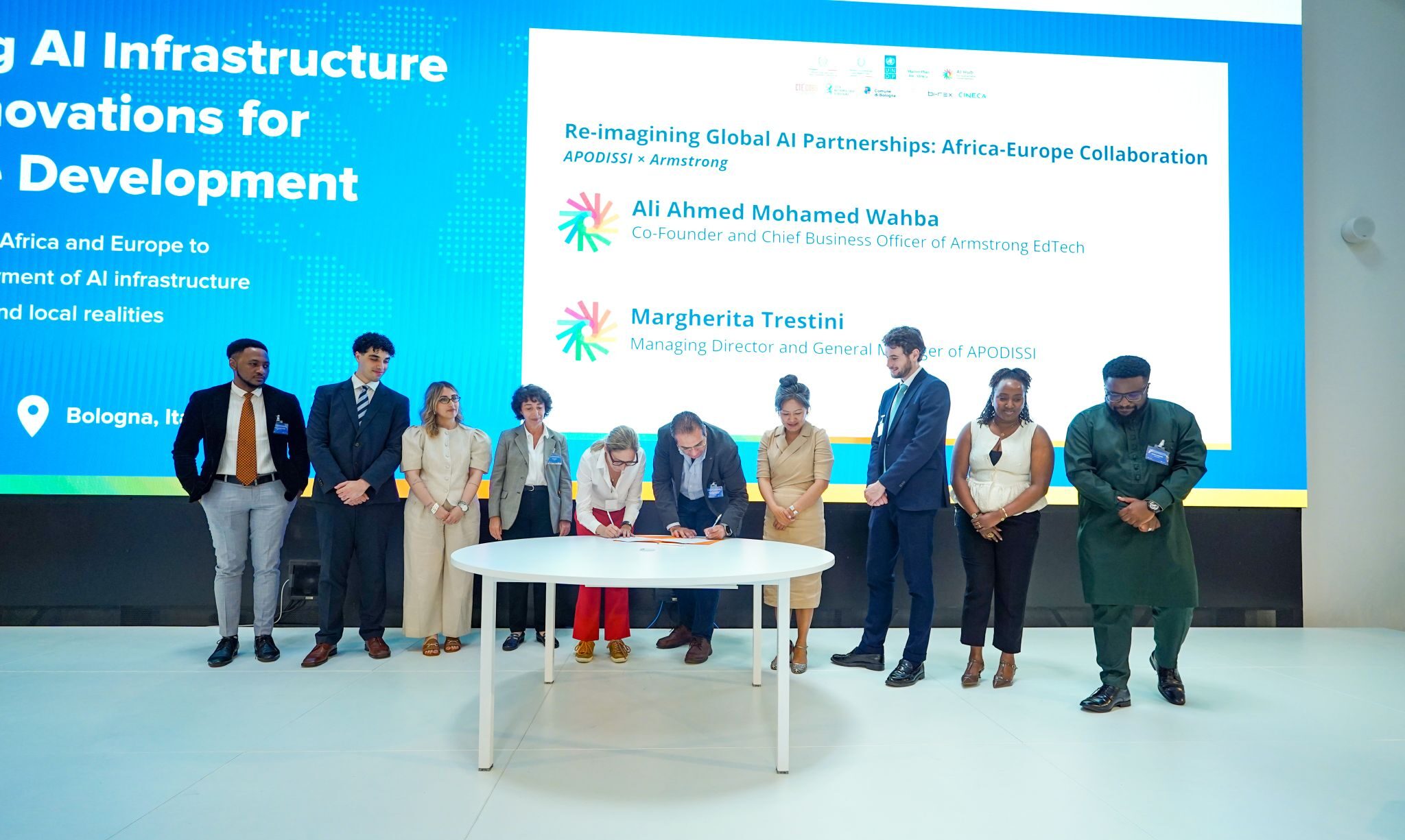
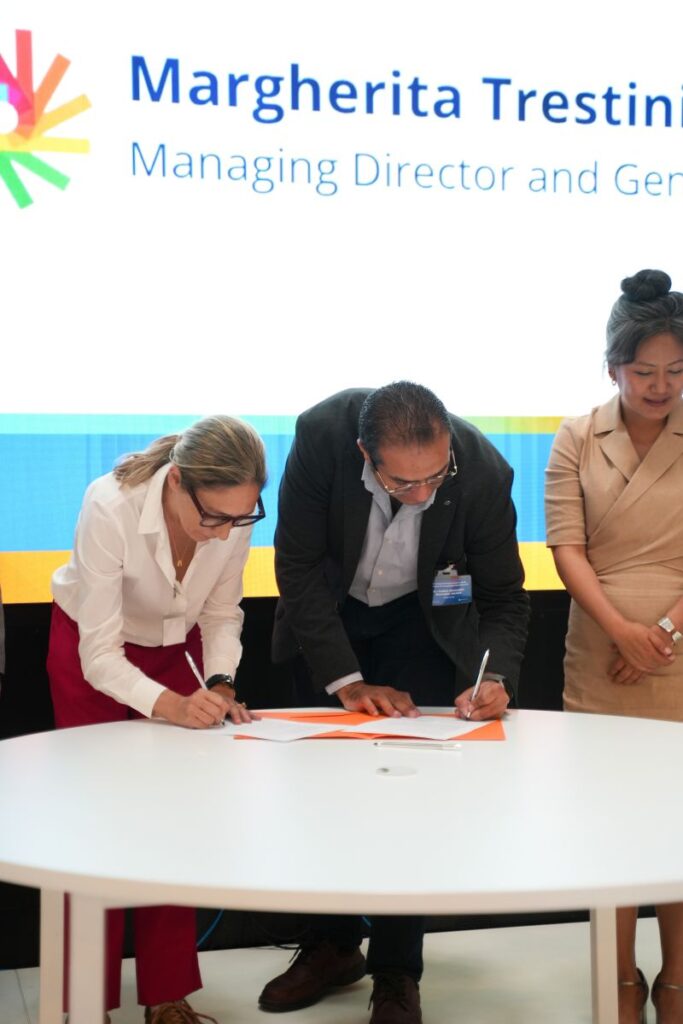
The Letter of Intent signed by Margherita Trestini, Managing Director of Apodissi, and the Egyptian startup Armstrong paves the way for the integration of Agentic AI technologies into the multilingual Smart Step e-learning platform, which currently serves more than 2,500 learners.
On 15 June 2026, the Tecnopolo Data Factory in Bologna hosted the Bologna AI Hub Ecosystem Event, Right-Sizing AI Infrastructure to Scale Innovations for Sustainable Development. The event brought together policymakers, universities, research centres, startups, companies and international organisations to explore how Artificial Intelligence infrastructure can be designed and deployed to support sustainable development across Europe and Africa.
The AI Hub for Sustainable Development is endorsed by the G7 leaders and co-lead by the Italy’s Ministry of Enterprises and Made in Italy and UNDP in line with the Italy-Africa Mattei Plan.
At the heart of the discussion was the need to build AI infrastructure that reflects real local demand, energy availability, connectivity requirements and development priorities.
A recurring theme was the transition from “latent AI” to AI that delivers real-world value. Ville Wacklin, Senior Advisor to the AI Hub and Data Centre Research Expert, highlighted the concentration of computing capacity in a limited number of African countries and stressed the need for more distributed, sustainable and accessible infrastructure. His intervention addressed key challenges including data localisation, energy constraints, Africa-Europe connectivity and the importance of building right-sized infrastructure that aligns computing capacity with actual demand.
Data and infrastructure sovereignty also emerged as central topics. Speakers stressed the importance of developing local AI models that are sustainable, compliant and capable of addressing context-specific needs. Regulatory compliance, safety and data protection were identified as essential foundations for building trust, strengthening competitiveness and enabling long-term innovation.
The session linking supercomputing and industrial applications featured contributions from Alessandro Chiarini of BI-REX, Claudio Arlandini of CINECA, Professor Paolo Bellavista of the University of Bologna and Marco Cappellini, CEO and Co-Founder of ArtCentrica. Chiarini presented the “Test Before Invest” approach, which helps small and medium-sized enterprises experiment with advanced technologies before committing resources. Arlandini showcased CINECA’s role in providing access to high-performance computing, cloud infrastructure and quantum technologies, while Bellavista highlighted the University of Bologna’s work in supporting AI adoption across manufacturing, logistics and automation. Cappellini shared practical experiences in technology transfer and AI-assisted image categorisation, demonstrating how advanced technologies can be translated into concrete business applications.
The event also featured leading African innovators. Ian Wambai, CEO of Africa Compute Fund, discussed the role of universities in talent development and the challenges startups face when moving from prototype to production. Mohamed Nabil, CEO of Widebot, highlighted the importance of developing language models tailored to local languages and contexts, while Raymond Ononiwu, CEO of Horus Labs, stressed the need to focus on meaningful use cases while addressing infrastructure and regulatory barriers.
Roberto Ridolfi, Senior Strategy Advisor at AfCEN, drew attention to the mismatch between computing supply and demand across Africa and the underutilisation of existing data centres. He presented examples from geospatial, financial and energy sectors, emphasising the importance of creating ecosystems capable of transforming innovative ideas into scalable and investable projects.
Bologna and the Emilia-Romagna region were described as one of Europe’s leading innovation ecosystems. Participants learned about the role of the Technopole, EU-supported AI Factories, startup acceleration programmes, technology transfer initiatives, and the extensive support network available to innovators through the regional ecosystem. A representative from ART-ER, the Emilia-Romagna innovation agency, showcased how the region fosters growth by connecting research, business, institutions and local communities. With approximately 7.5% of Italy’s innovative startups based in Emilia-Romagna, the region has established itself as a gateway for innovation, attracting significant investments and serving as a model for technology-driven economic development.
One of the most significant moments of the event was the session entitled “Re-imagining Global AI Partnerships: Africa-Europe Collaboration”, which focused on establishing new collaborations between African startups and European organisations. In her introduction, Giulia Vitagliano, Lead for Partnerships at the AI Hub for Sustainable Development, stressed the importance of building stronger alignment between Africa, Italy and broader G7 initiatives. She highlighted cooperation as a driver of development and called for stronger cross-regional partnerships to develop “solutions fit for purpose”, while ensuring the efficient use of resources. During the official session, Margherita Trestini, Managing Director of Apodissi, partner of DataScientia, signed a Letter of Intent with the Egyptian startup Armstrong.
The agreement launches a collaboration aimed at integrating Agentic AI technologies into Apodissi’s multilingual Smart Step e-learning platform. The partnership will explore the deployment of intelligent agents capable of supporting learners throughout their educational journey, providing personalised assistance, facilitating content navigation and enhancing the overall learning experience.
For Apodissi, participation in the event was particularly relevant as it aligns closely with the organisation’s mission to promote digital innovation, skills development and technology-driven transformation through education. Smart Step currently serves more than 2,500 learners and offers a portfolio of 10 multilingual courses focused on professional, entrepreneurial and digital skills development.
The integration of Agentic AI solutions will open new opportunities for personalised learning and further strengthen Smart Step’s role as an innovative platform for education and international capacity building. The signing of the Letter of Intent also represents a concrete outcome of the Africa-Europe dialogue promoted by the AI Hub for Sustainable Development.
The event concluded with one thematic table entitled “Disaggregating Innovation Systems in Europe and Africa”, designed to explore how the different actors within innovation ecosystems interact, depend on one another and collectively enable resilient and scalable innovation systems. Rather than viewing innovation as a linear process, participants examined it as a network of interconnected institutions including universities and research centres, private sector actors, governments, investors, civil society organizations and innovation support structures.
Through a comparative Africa-Europe lens, the discussions focused on the specific role of each ecosystem actor, the conditions required for effective operation, the interdependencies that support innovation deployment, and the bottlenecks that often prevent promising ideas from reaching scale. Attention was given to identifying partnerships and coordination mechanisms capable of strengthening innovation ecosystems as a whole and accelerating the transition from research and experimentation to practical implementation.
The conference closed with a shared commitment to strengthening Europe-Africa cooperation in building inclusive, sustainable and demand-driven AI infrastructures capable of transforming research, technology and innovation into tangible opportunities for economic and social development.