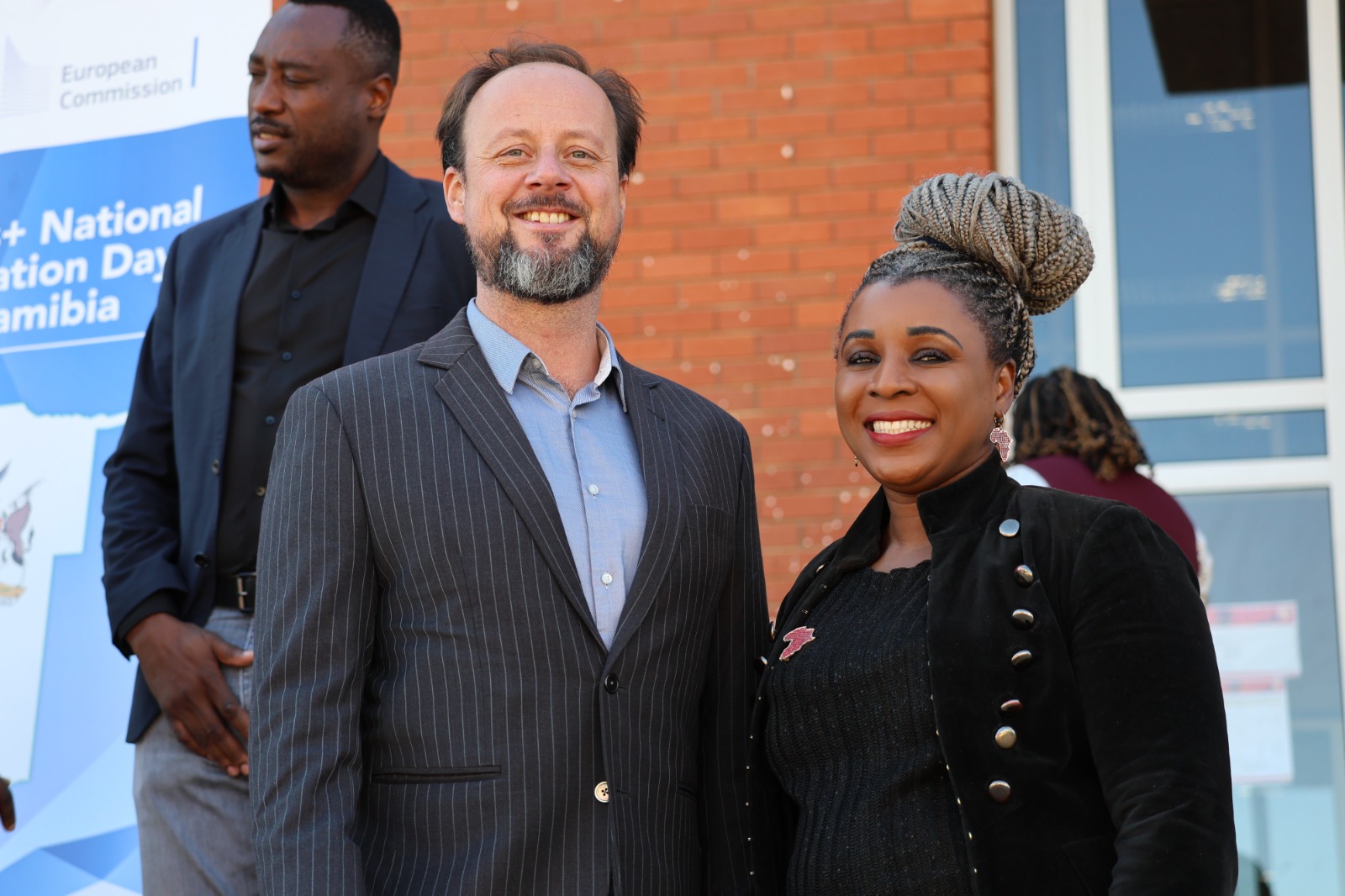
Researchers, academics, higher education leaders, development practitioners and innovation stakeholders gathered at the University of Namibia (UNAM) for the Horizon Europe and Erasmus+ Information Session and Coaching Event, organised jointly by the European Union Delegation to Namibia, UNAM, EURAXESS Africa, the Erasmus+ and Horizon Europe National Focal Points, and partners from the SHINE Project.
Held at the UNAM Leisure Centre and attended by approximately 250 participants both in person and online, the hybrid event aimed to raise awareness of European Union funding opportunities available to higher education institutions and research organisations across Namibia and Africa.
The session focused on three flagship European Union programmes: Horizon Europe, Erasmus+ Capacity Building in Higher Education (CBHE), and the Marie Skłodowska-Curie Actions (MSCA), all designed to strengthen research excellence, innovation, international collaboration and institutional capacity development.
Opening the event, Mr. Ian Dupont, Deputy Ambassador of the European Union to Namibia, underscored the importance of strengthening the Africa–Europe partnership through education, research and innovation.
“Africa and Europe have committed to a renewed partnership that places education, research and innovation at its centre. These programmes are open to you, they need your expertise, and we want to see many more applications from Namibia and from Africa.”
Mr. Dupont highlighted that African universities and researchers are increasingly succeeding in securing competitive EU funding, coordinating international consortia and leading impactful research initiatives. He encouraged Namibian institutions to actively engage with funding opportunities and position themselves as key contributors to global scientific advancement.
The Deputy Ambassador further showcased Namibia’s growing prominence in international research through the Africa Millimetre Telescope (AMT) initiative, a collaboration between UNAM and international partners that recently secured a €14 million European Research Council Synergy Grant. The project demonstrates Namibia’s potential to become a hub for scientific excellence while strengthening local capacity in physics, engineering, data science and advanced instrumentation.
Representing Apodissi, Senior Dissemination and Communication Specialist Ina Willibard participated in the event to explore opportunities for future collaboration with higher education institutions, researchers, innovation actors and development partners.
For Apodissi, the event was particularly relevant as the organisation continues to foster partnerships that contribute to research excellence, innovation, skills development and sustainable development in Namibia. Through its work with municipalities, TVET institutions, youth organisations, civil society actors and international partners, Apodissi supports initiatives that bridge education, research and practical application.
Since establishing its presence in Namibia, Apodissi has built partnerships with public institutions, local authorities, vocational training providers and community organisations to strengthen capacity building and innovation. Through the CircuWasteVETAfrica project, the organisation has collaborated with the Swakopmund Municipality to promote circular economy approaches and sustainable waste management practices. Apodissi has also engaged with youth organisations such as Youth4CAN and vocational training institutions through initiatives focused on green skills, entrepreneurship, digital transformation and smart logistics.
The information session provided valuable insights into European Union funding instruments that support collaborative research, institutional development and innovation-driven projects. It also created opportunities to engage with potential partners in areas aligned with Apodissi’s priorities, including green skills development, circular economy solutions, digital innovation, sustainable resource management and renewable energy.
As Apodissi recently launched the GH-SAFE project, which aims to develop sustainable and safe solar-to-hydrogen production solutions for rural African communities, the event provided an important platform to connect with Namibian researchers and institutions working in the hydrogen, renewable energy and innovation sectors. Namibia’s growing leadership in green hydrogen development presents significant opportunities for future research collaboration, knowledge exchange and the uptake of project results.
The event also provided an opportunity to showcase two Erasmus+ funded initiatives currently being implemented by Apodissi in Namibia.
The SYNAPSE Project (Systems Shift EU–Africa: Empowering Youth through Systems Thinking and Transcontinental Exchange) is co-funded by the European Union through the Erasmus+ Programme and aims to empower young people across Europe and Africa through systems thinking, virtual exchanges and collaborative learning experiences. The project brings together partners from seven countries and seeks to engage 2,500 young people while strengthening youth participation, inclusion and cross-continental dialogue.
The SUSTAIN-IT Project focuses on strengthening Technical and Vocational Education and Training (TVET) through innovative approaches to environmental monitoring, digital technologies, social entrepreneurship and inclusive teaching practices. The project equips educators and young people with practical tools and competencies to address sustainability challenges while fostering green and digital skills.
Both projects leverage the Smart Step eLearning Platform, managed by Apodissi, to support capacity building, knowledge sharing, online learning and the dissemination of project results to wider audiences across Africa and Europe.
Reflecting on the event, Ina Willibard noted that networking opportunities such as these are essential for strengthening collaboration between higher education institutions, researchers, civil society organisations and development partners, while creating pathways for future participation in international research, innovation and capacity-building initiatives.
By participating in the Horizon Europe and Erasmus+ Information Session and Coaching Event, Apodissi reaffirmed its commitment to advancing international cooperation, supporting innovation ecosystems and contributing to sustainable development through research, education and skills development partnerships in Namibia and across Africa.